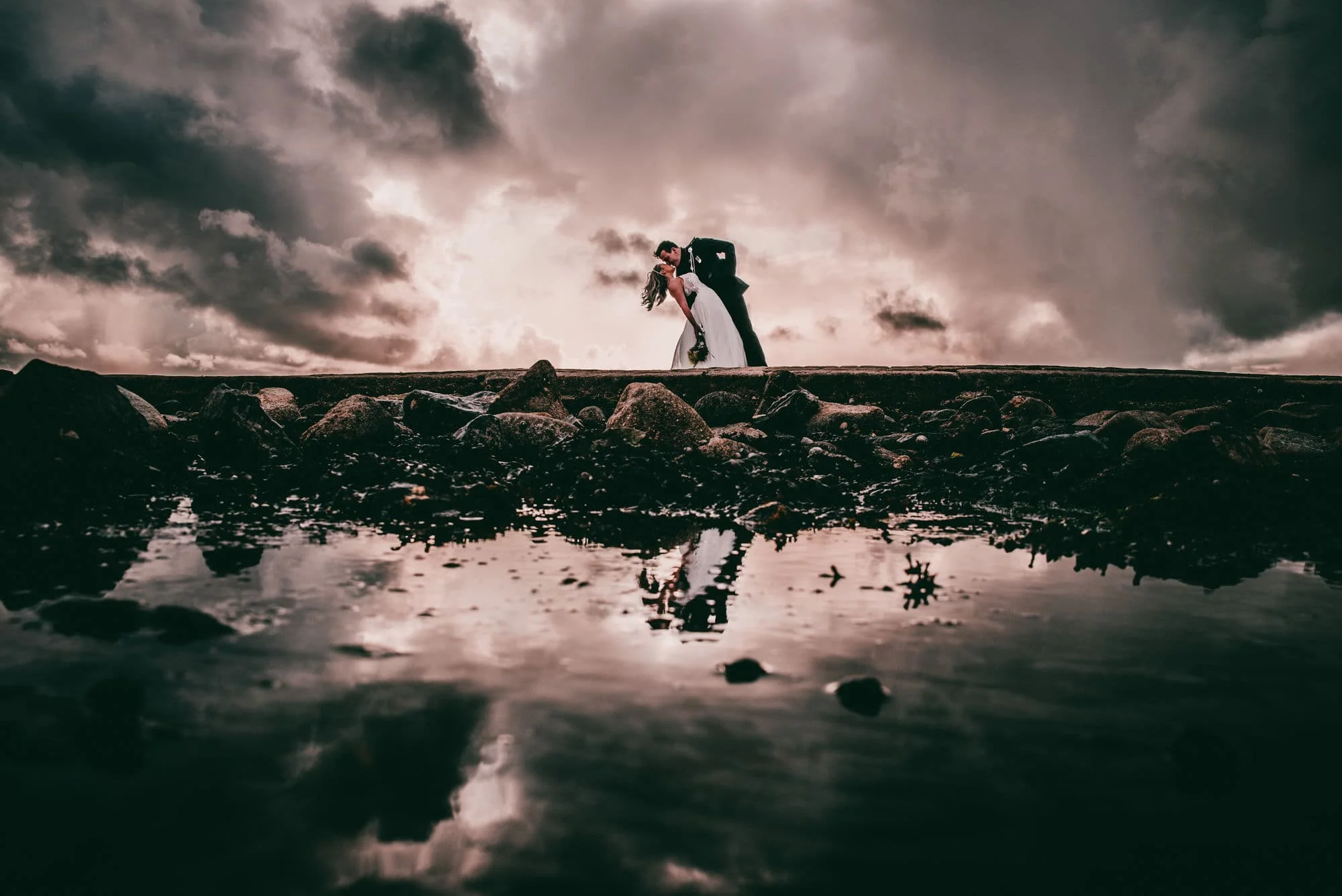
Eloping in Cornwall has become one of the most common questions that lands in my inbox, usually from couples who've looked at a big traditional wedding, done the maths, and thought "actually, no." I understand it completely. I've stood on Marazion Beach with a couple who'd slipped away for a quiet ceremony, and I've watched them relax. The tide gently rolling in around St Michael's Mount sitting proudly in the background, and for a little while there's nothing to think about except the two of them. No seating plan, no timelines, no pressure, just a chance to be together and soak it all in. Just the sea, doing what it does. If you're weighing up whether to elope down here, these are the five reasons I keep coming back to, drawn from actual days on actual beaches rather than anything abstract.
1. The Coastline Does the Decorating For You
West Cornwall doesn't need help. Land's End at first light, the granite stacks off Sennen Cove, the old engine houses at Botallack with the Atlantic behind them, Kynance Cove with its serpentine rock going green and purple depending on the tide. None of it needs flowers wired to it or fairy lights strung through it. When your venue is a headland, your photographs have a scale and a drama that a marquee, however lovely, simply can't give you. I say this gently to couples every year: you can spend three months and a decent chunk of your budget building an aesthetic, or you can turn up at Portheras Cove and let millions of years of geology do it for free.
Where couples elope in Cornwall
The spots I'd recommend most often are Land's End, Sennen, Porthcurno (particularly if you can get access near the Minack Theatre), Cape Cornwall, and Kynance Cove down on the Lizard. Further along the north coast, Bedruthan Steps and the cliffs near Trevose Head both work beautifully in a stiff onshore wind, which, let's be honest, is a fairly safe bet in Cornwall at any time of year.
2. A Smaller Guest List Means More Time, and Better Light
A sixty-person wedding runs on a timetable. An elopement runs on the tide table, which I'd argue is more romantic anyway. Without a room full of people to feed, seat, and photograph in careful groups, we can chase the good light instead of the schedule. That might mean a seven o'clock ceremony so we get the low gold sun raking across the water, or it might mean waiting out a shower under the cover of a cove and walking out the moment it clears, which happens more often in Cornwall than you'd think. Fewer guests also means fewer compromises: no arguing over dates that suit twelve families, no distant cousin who has to be in the front row.
3. It's Legally Simpler Than People Assume
A lot of couples believe eloping means the marriage isn't "real," which isn't true at all. In England and Wales you can have a fully legal ceremony on a beach or clifftop if you use an independent celebrant alongside a separate registrar appointment (many couples give notice and register the marriage quietly at Penzance Register Office beforehand or after), or you can have a legal ceremony at an approved venue nearby and then walk straight out to the coast for photographs and a celebrant-led blessing that actually feels like your wedding. Either way, you'll need to give notice at least 28 days before the date, and if either of you lives outside the UK there are extra steps, so it's worth starting that paperwork early. A good local celebrant or registrar will talk you through exactly which route suits you.
4. Your Budget Goes Where It Actually Matters
Without catering for eighty people, hiring a marquee, or paying for a dance floor nobody uses until eleven o'clock, your budget stretches a long way. I've had couples redirect what they saved into two full days of photography instead of six hours, into a proper celebrant rather than a rushed slot, into staying somewhere lovely like a granite cottage above Mousehole for a week afterwards instead of one night in a hotel. The best part of eloping isn't just spending less. It's spending well, on the things that actually make the day feel considered rather than just correct.
5. The Photographs Become the Whole Record
With a big wedding, there's a video, a hundred guests' phone photos, a band, a speech nobody remembers word for word. With an elopement, the photographs are often the only record of the day, which changes how I work. I'm not there to snap a few formal shots between courses; I'm documenting the entire arc of it; the walk down, the vows, the wind taking the veil sideways, the bit afterwards where you finally exhale and someone laughs about nothing in particular. Those in-between moments are what you'll actually want to look at in twenty years, more than any posed line-up ever gave you.
A few practical notes if you're planning one Bring a coat even in July (the wind off the Atlantic doesn't check the calendar), choose shoes you can walk on grass or sand in, and build in a weather backup, a cove or barn nearby rather than a plan B forty minutes away. Late spring and early autumn tend to give the calmest light and the smallest crowds on the coast path, though a bright, blustery February morning on the cliffs can be just as good, arguably better, if you don't mind pink noses in the photographs. Eloping down here isn't a smaller version of a wedding. For a lot of couples, it turns out to be the whole point, just the two of you and this corner of Cornwall, and a set of photographs that actually look like your life rather than a performance of it.
Have questions? Let's chat.
I'd love to hear about what you have in mind.